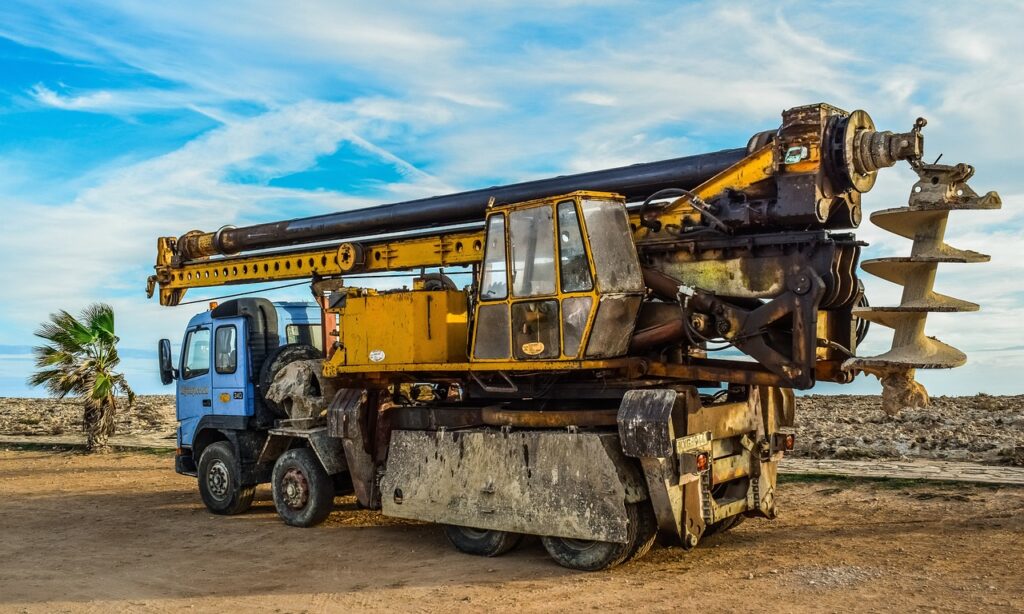
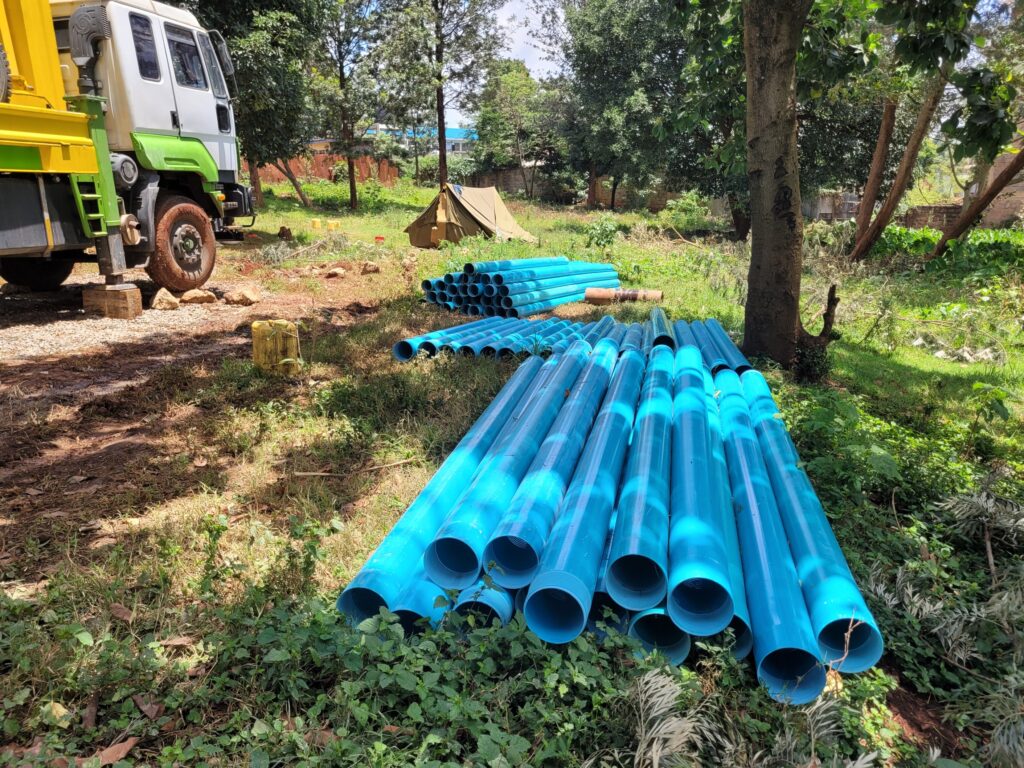
Across Kenya, an underground revolution is happening. The numbers are staggering, and they tell a story every property owner should understand before reaching for the phone.
This guide walks you through everything you need to know about drilling a borehole in Kenya, before you commit to a project. The full process, the permits, the regional realities, and the decisions that separate a borehole that lasts 30 years from one that fails in 30 months.
Table of Contents
- Why Kenya is in the Middle of a Borehole Boom
- How to Know You Actually Need a Borehole
- Is Your Site Right for a Borehole? Understanding Kenya’s Geology
- The Full Borehole Drilling Process in Kenya
- Real Kenyan Examples of Borehole Success and Failure
- How Long Does a Properly Drilled Borehole Last?
- Common Mistakes That Cause Boreholes to Fail Early
- How to Choose the Right Borehole Drilling Contractor in Kenya
- Frequently Asked Questions
Why Kenya is in the Middle of a Borehole Boom
According to the Kenya National Bureau of Statistics (KNBS) Economic Survey 2025, a total of 47,199 boreholes were drilled in 2024 to 2025 alone. That is up from just 15,418 in 2018 to 2019. In six years, the country has more than tripled its annual borehole drilling rate.
What is driving the surge? A combination of unreliable municipal water supply, climate driven rainfall variability, rapid peri urban expansion, and rising demand from farms, schools, hotels, factories, and real estate developments. Roughly 40 to 50 percent of Kenya’s population still lacks reliable access to clean drinking water.
In Nairobi, the Nairobi City Water and Sewerage Company can only meet a fraction of the city’s true demand. Kenyans are no longer waiting for piped water. They are creating their own water security, borehole by borehole.
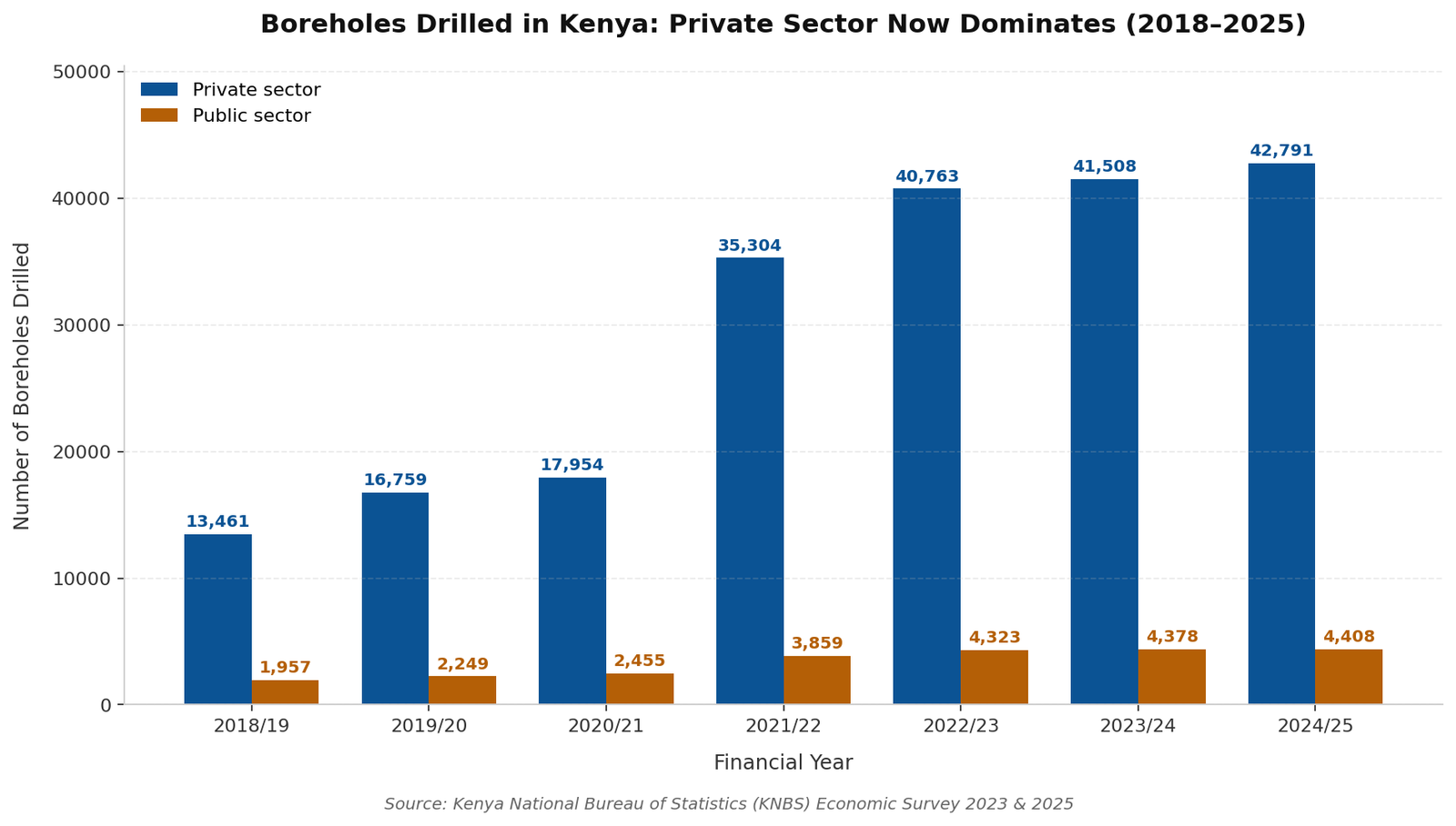
What stands out in the data above is the private sector’s dominance. In 2024 to 2025, private players drilled 42,791 boreholes while public institutions drilled just 4,408. That means over 90 percent of new boreholes in Kenya are now privately funded.
Homeowners, farmers, schools, and SMEs have become the engine of the country’s water security. If you are reading this, you are almost certainly thinking about joining them.
Thinking about a borehole for your property?
Talk to a licensed Bonvic Drilling engineer before you commit to anything. 📞 Call +254 720 545 191 or 💬 WhatsApp us here for a free site assessment.
How to Know You Actually Need a Borehole
Before reaching for the phone, it helps to confirm a borehole is the right solution. The clearest signs are practical.
- Your tap runs dry for two or more days a week, or you depend on water bowsers.
- Your monthly water bill or bowser spending has crossed the level of a small loan repayment.
- You run a farm, livestock unit, car wash, school, hotel, or rental block where water interruption directly hits your revenue.
- You are building a home in a peri urban or rural area where no piped supply exists.
- You want to install a swimming pool, large garden, or irrigation system.
- You operate a business in counties with chronic shortages: Kajiado, Machakos, Makueni, Kitui, Turkana, Garissa, Wajir, Mandera.
A borehole is essentially a decades long water infrastructure investment. Once drilled, equipped, and registered, it provides water independence. In many areas, it also adds significant value to a property.
Is Your Site Right for a Borehole? Understanding Kenya’s Geology
Kenya’s geology is dramatically varied, and that variation determines almost everything about your borehole. Depth, yield, water quality, casing requirements, and longevity all depend on what lies beneath your specific plot. You can read more on this in our guide to the average water table in Kenya.
The chart below shows typical drilling depths across the country’s main regions.
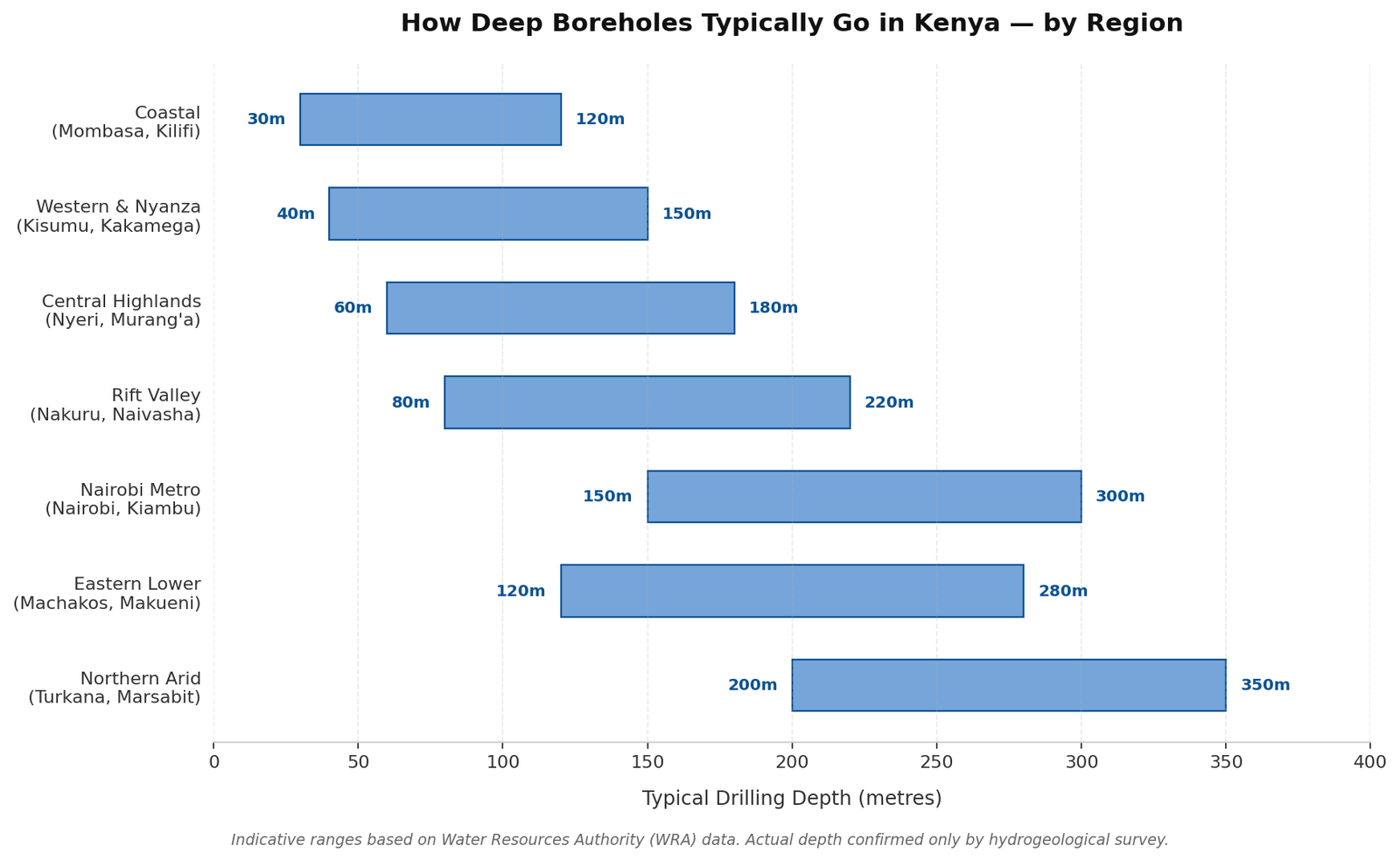
A few patterns are worth noting.
Coastal areas (Mombasa, Kilifi, Kwale) have the shallowest water tables. Sometimes water is struck within 30 to 60 metres. But salinity and seawater intrusion are real risks near the shoreline, which is why we wrote a dedicated piece on predicting borehole water salinity before drilling.
Western Kenya and Nyanza (Kisumu, Kakamega, Bungoma) generally have favourable groundwater conditions. Higher rainfall and weathered rock formations contribute to good yields.
The Central Highlands (Nyeri, Murang’a, Kirinyaga) typically yield good water at 60 to 180 metres. Some areas hit hard volcanic rock that requires specialised drilling.
Nairobi and the Rift Valley are tricky. Nairobi’s upper aquifer is heavily over extracted, so most new boreholes must reach the second aquifer (often 150 to 300 metres). Parts of the Rift Valley (Nakuru, Naivasha, Baringo) also carry naturally high fluoride levels.
Lower Eastern Kenya (Machakos, Makueni, Kitui) often requires deeper drilling through hard formations. Arid Northern Kenya (Turkana, Marsabit, Mandera, Wajir) is the most demanding. Drilling can exceed 300 metres, and projects need careful siting because dry holes are common.
This is precisely why a hydrogeological survey is not optional. Drilling blindly is the single most expensive mistake a property owner can make.
The Full Borehole Drilling Process in Kenya, Step by Step
Here is the complete process a properly executed borehole project follows in Kenya. There are no shortcuts. Skipping or compressing any of these steps is the single biggest predictor of borehole failure.
Step 1: Initial Site Assessment and Client Brief
A licensed drilling contractor visits your site to understand your needs in detail. The visit covers your intended water use (domestic, irrigation, livestock, commercial, or industrial), your estimated daily water demand, and the available space for the drill rig. A 25 tonne rig needs real access.
We also assess the power source for the eventual pump, whether mains electricity, solar, or hybrid. We look at existing structures, boundary walls, and underground services. The output is a project brief that informs the survey and permitting stages.
Step 2: Hydrogeological Survey
This survey is conducted by a geologist licensed by the Water Resources Authority (WRA). It uses geophysical methods, most commonly Vertical Electrical Sounding (VES) and Electromagnetic (EM) profiling. The goal is to map subsurface layers and identify water bearing zones, known as aquifers.
The deliverable is a stamped hydrogeological report. It recommends the exact drilling point on your property, the anticipated drilling depth, the expected aquifer depth and yield range, the casing and screening recommendations, and a risk assessment for water quality issues such as fluoride, salinity, or iron.
This document is mandatory for permit applications. No reputable contractor will drill without it.
Step 3: Permits and Legal Compliance
Kenya’s Water Act 2016 strictly regulates groundwater abstraction. You need three approvals before a single metre is drilled.
| # | Permit or Approval | Issued by | Purpose |
|---|---|---|---|
| 1 | Authorisation to Drill | Water Resources Authority (WRA) | Confirms the proposed borehole complies with aquifer management rules and spacing (at least 800 m from the nearest borehole) |
| 2 | EIA Licence | National Environment Management Authority (NEMA) | Ensures the project will not damage the environment, especially in protected zones |
| 3 | No Objection Letter | County Government or local water service provider | Confirms no conflict with existing water infrastructure |
Permits typically take 2 to 6 weeks depending on location and complexity. A good drilling contractor handles the paperwork on your behalf.
Important: Drilling without permits is illegal. The WRA actively decommissions unregistered boreholes. Unregistered boreholes also cannot be legally connected to most insurance, mortgage, or commercial financing structures.
Step 4: Mobilisation and Drilling
The drilling rig is mobilised to your site. Drilling typically takes 2 to 5 days. The duration depends on the required depth, rock hardness (volcanic basalt is the slowest, sedimentary layers are faster), weather conditions, and access.
During drilling, the contractor logs every metre. We record soil and rock types, water strikes, and any anomalies. This drilling log becomes a permanent record of your borehole.
Step 5: Casing, Screening, and Grouting
Once the hole reaches target depth, steel or uPVC casing is installed to prevent collapse and contamination. The choice of casing material is critical, which we explain in detail in our guide to PVC vs steel borehole casing in Kenya. Slotted screens are placed at water bearing zones to allow water in while keeping out sand and silt.
The annular space around the casing is then filled with a gravel pack to filter out fines. It is capped with a bentonite or cement grout seal near the surface to prevent surface contaminants from seeping down.
This is where many Kenyan boreholes fail. Cutting corners on casing material, gravel grading, or grouting is the single most common cause of early borehole collapse. Most failures only appear months later, when repair is far more expensive than doing it right the first time.
Step 6: Borehole Development
After construction, the borehole is “developed”. This means it is flushed and surged to remove drilling debris, fine sediments, and any residual mud.
Proper development can dramatically improve the lasting yield of the borehole. Skipping it leaves the borehole sluggish for life.
Step 7: Test Pumping
A test pump runs continuously for 24 to 72 hours. It measures four critical values: the static water level (resting level of water in the borehole), the dynamic water level (how far the level drops during pumping), the yield (litres per hour the borehole can sustainably deliver), and the recovery rate (how quickly the water level returns after pumping stops).
This data determines the correct pump size, pump setting depth, and recommended pumping schedule. Over pumping a borehole, that is running a pump too large for the yield, is one of the fastest ways to destroy it.
Step 8: Water Quality Testing
A water sample is sent to a certified laboratory for analysis. The full set of parameters and why they matter is covered in our piece on borehole water quality testing in Kenya.
- pH and total dissolved solids (TDS)
- Bacterial contamination (E. coli, total coliforms)
- Fluoride (critical in Nakuru, Kajiado, Naivasha, Baringo)
- Heavy metals (iron, manganese, lead, arsenic)
- Salinity (critical in coastal regions)
- Nitrates and nitrites (critical near farms)
In Gilgil, Nakuru County, studies have found over 70 percent of residents showing signs of dental fluorosis from unfiltered borehole water. That is a sobering reminder. Finding water is only half the job. Making it safe is the other half.
Step 9: Pump Installation and Commissioning
Based on the test pumping results, the right submersible pump is installed at the correct depth. Pump options include electric submersibles (best where mains power is reliable), solar powered pumps (increasingly popular in off grid and rural areas; eliminates monthly electricity costs), and hybrid systems (solar with grid backup for full reliability).
A wellhead, control panel, rising main, and storage tank are connected. The system is commissioned and handed over with full documentation.
Step 10: Registration and Handover
The completed borehole is registered with the WRA. You receive a registration certificate, drilling log, hydrogeological report, water analysis certificate, test pumping data, and an operation and maintenance manual.
This documentation is essential. It is required for property valuation, insurance, refinancing, and any future repair work.
Ready to start your borehole project the right way?
Bonvic Drilling handles every step above, from the WRA permits to the final commissioning. 📞 Call +254 720 545 191 or 💬 WhatsApp us for a free site visit.
Real Kenyan Examples of Borehole Success and Failure
Example 1: A homeowner in Kitengela, Kajiado County
After three years of relying on water bowsers for a four bedroom home with a young family, the owner commissioned a 180 metre borehole. The hydrogeological survey identified a productive aquifer.
Within four months, the family eliminated bowser dependency completely. A neighbour now buys excess water for a small commercial nursery.
Example 2: A poultry farm in Thika, Kiambu County
A 5,000 bird poultry farm faced production losses during Nairobi water rationing. After installing a properly sized borehole with a solar pump and 10,000 litre storage, water interruptions disappeared.
Egg production stabilised. The farm expanded to 8,500 birds within 18 months.
Example 3: A failed borehole in Machakos County (the cautionary tale)
A community group skipped the proper hydrogeological survey and hired the cheapest contractor available. The borehole collapsed within three months due to inadequate casing.
Total rehabilitation ended up costing more than triple what a proper job would have cost upfront. The community lost six months without water.
The pattern is consistent across the country. Borehole success is determined long before the drill bit touches the ground. It is decided by the quality of the survey, the contractor’s experience with your specific geology, the materials used, and the documentation filed.
How Long Does a Properly Drilled Borehole Last?
A carefully designed, properly maintained borehole in Kenya can deliver clean water for 30 to 50 years. The maintenance schedule below extends borehole life and protects your investment.
| Frequency | Maintenance Activity |
|---|---|
| Monthly | Visual inspection of the wellhead, control panel, and surroundings |
| Quarterly | Water quality test (pH, bacteria, hardness); pump performance check |
| Annually | Full system inspection; pump amperage and pressure check; tank cleaning |
| Every 3 to 5 years | Camera inspection of casing and screens; borehole flushing |
| As needed | Pump replacement (typical pump life: 7 to 15 years depending on water chemistry) |
A Kenya Water Institute study found that boreholes receiving quarterly professional inspections experienced 64 percent fewer major breakdowns than those left unattended. If your borehole is already showing trouble, see our guide on signs your borehole needs flushing.
Common Mistakes That Cause Boreholes to Fail Early
After analysing hundreds of borehole projects across Kenya, the same mistakes appear again and again. Many of these issues are covered in detail in our resource on common borehole problems and how to fix them.
- Skipping the hydrogeological survey to “save money”, and ending up with a dry hole.
- Hiring a contractor not licensed by the WRA. Work that cannot be registered cannot be insured.
- Using thin or substandard casing to cut upfront cost, leading to collapse within a year or two.
- Inadequate grouting at the surface, allowing contaminants to seep down into your aquifer.
- Installing an oversized pump, which over draws the aquifer and burns out the pump.
- Skipping water quality testing, then only discovering high fluoride or bacterial contamination after months of use.
- No registration with the WRA. This makes the borehole legally invisible and uninsurable.
- No maintenance plan. A perfectly good borehole degrades into an expensive emergency.
Every single one of these mistakes is preventable when you work with a properly licensed, experienced drilling contractor from day one.
How to Choose the Right Borehole Drilling Contractor in Kenya
The choice of contractor is the single most important decision in your borehole project. For a fuller breakdown, read our complete guide on how to choose the best borehole drilling company in Nairobi.
Use this checklist when comparing contractors:
- ✅ Licensed by the Water Resources Authority (WRA)
- ✅ Holds a National Construction Authority (NCA) registration where applicable
- ✅ Works with WRA licensed hydrogeologists for surveys
- ✅ Provides a written quotation with itemised scope (survey, permits, drilling, casing, development, test pumping, water test, pump, commissioning)
- ✅ Can show you drilling logs and registration certificates from recent projects
- ✅ Offers ongoing maintenance contracts after installation
- ✅ Has experience drilling in your specific region (geology varies enormously)
- ✅ Provides clear, written warranties on casing and workmanship
- ✅ Has insurance cover for the drilling crew and your property
- ✅ Provides full documentation handover at project completion
If a contractor cannot tick every one of these boxes, walk away. The savings are never worth it.
At Bonvic Drilling, we tick every box above. View our full range of services or browse our completed projects to see what proper borehole work looks like.
Frequently Asked Questions
How long does the entire borehole drilling process take in Kenya?
From survey to commissioning, expect 4 to 10 weeks. Most of the time is spent on permits (2 to 6 weeks), not drilling. Actual drilling rarely takes more than 5 days.
Do I need a permit to drill a borehole on my own land?
Yes. The Water Act 2016 requires WRA authorisation before drilling, plus a NEMA EIA licence, regardless of whether the land is yours. Groundwater is a shared national resource.
Can a borehole really run dry?
Yes, especially shallow boreholes in over extracted areas like Nairobi’s first aquifer, or during prolonged droughts in arid counties. A proper hydrogeological survey minimises this risk by targeting the right aquifer at the right depth.
Is solar pumping a good option for Kenyan boreholes?
Often yes, particularly in off grid areas or where electricity costs are high. Solar systems have a higher upfront cost but eliminate monthly power bills and continue working during outages.
Will a borehole increase my property value?
A properly registered, fully documented borehole typically adds significant value to a property. This is especially true in peri urban areas of Nairobi, Kiambu, Kajiado, and Machakos where municipal water is unreliable.
What is the difference between a shallow well and a borehole?
A shallow well (under 30 metres) usually taps the first water table and is vulnerable to contamination and drought. A proper borehole reaches deeper, protected aquifers. It delivers more consistent, cleaner water all year round.
Ready to Drill? Start With a Free Site Assessment
Every successful borehole in Kenya begins the same way. A proper site visit and hydrogeological survey by qualified professionals.
If you are considering a borehole for your home, farm, school, estate, or business, the smartest first step is a free site assessment. We will review your site conditions, water needs, and the specific geology of your area. Then we will tell you exactly what to expect before you commit to anything.
Get your free borehole site assessment today
Speak to a licensed Bonvic Drilling engineer. No obligation, no pressure.
📞 Call +254 720 545 191 | 💬 WhatsApp Us
Or visit our contact page to send a message.
Water independence is one of the best lasting investments any Kenyan property owner can make. Done right, your borehole will outlast every other system on your property.
Sources: Kenya National Bureau of Statistics (KNBS) Economic Survey 2023 and 2025; Water Resources Authority (WRA); National Environment Management Authority (NEMA); Ministry of Water and Sanitation; Kenya Water Institute.