Kiambu County is one of the fastest growing regions in Kenya. With more than 2.4 million residents according to the Kenya National Bureau of Statistics (KNBS), the county now hosts some of the busiest urban and industrial corridors in the country.
From the sprawling estates of Ruiru, Juja and Kikuyu to the industrial parks of Thika, the agricultural belts of Githunguri and Limuru, and the high end developments of Tatu City and Tilisi, demand for reliable water has reached crisis levels. That is why borehole drilling in Kiambu has become one of the most important infrastructure investments any property owner, developer, school, farm or factory can make.
This 2026 pillar guide covers everything you need to know before drilling a borehole anywhere in Kiambu. We unpack the unique hydrogeology of the county, what depths to expect by sub county, the full drilling process, permits, real project examples, common challenges, and how to choose the right contractor.
Table of Contents
- Kiambu’s Growing Water Crisis
- Kiambu’s Unique Hydrogeology
- Borehole Depths by Kiambu Sub County
- Real Project Examples From Kiambu
- The Borehole Drilling Process in Kiambu
- Permits You Need in Kiambu
- Common Challenges Specific to Kiambu
- Borehole Drilling for Different Sectors
- Choosing the Right Contractor
- Borehole Maintenance and Lifespan
- Frequently Asked Questions
Kiambu’s Growing Water Crisis
Kiambu enjoys higher rainfall than most of Kenya, with annual averages between 800mm and 1,500mm depending on altitude. So why is the county facing a water crisis?
The answer is in the numbers. According to the 2019 Kenya Population and Housing Census, Kiambu’s population grew from 1.6 million in 2009 to 2.4 million in 2019, a rise of 50% in a single decade.
Towns like Ruiru and Juja have grown even faster. Ruiru alone has a population of more than 490,000, making it one of Kenya’s largest municipalities outside of Nairobi.
Water infrastructure has not kept up. The Ndakaini Dam, which sits within Kiambu and supplies Nairobi, has been operating below capacity in recent years due to changing rainfall patterns.
Local utilities including KIWASCO, RUJWASCO, THIWASCO, LIWASCO and Karuri Water are stretched thin. Rationing is now routine in many estates.
This is why boreholes have become the dependable backstop for homes, businesses and communities across the county. Our analysis of borehole versus county water costs shows just how much you can save over time.
What’s Driving Kiambu’s Borehole Boom
Top reasons clients cite when commissioning new boreholes in Kiambu
A properly drilled borehole eliminates these problems entirely. Once commissioned, it can deliver between 2,000 and 30,000 litres per hour depending on the aquifer.
With proper maintenance, your borehole will serve you for 30 to 50 years. Read our complete guide on how long a water borehole lasts for the full picture.
For developers and property owners in Kiambu, a registered borehole now adds substantial value to any property. This is particularly true in areas where municipal supply is unreliable.
Thinking About a Borehole in Kiambu?
Talk to a licensed Bonvic Drilling engineer today. Free site assessment, no obligation.
Kiambu’s Unique Hydrogeology
Kiambu sits on layered volcanic geology that creates challenging but rewarding drilling conditions. The county’s elevation ranges from about 1,500 metres in Ruiru and Juja to over 2,400 metres in parts of Limuru and Lari.
This elevation difference directly affects how deep you need to drill. Below the surface, Kiambu is dominated by three distinct geological systems.
Understanding these layers is essential before drilling. Our guide on the average water table in Kenya explains the wider context.
The Volcanic Upper Layer (0 to 80 metres)
The top section across most of Kiambu consists of weathered volcanic ash, tuffs and red soils overlying harder rock. Some very shallow water exists in this zone, particularly in the upper highland areas.
However, this water is generally unreliable, prone to seasonal fluctuation, and easily contaminated by surface activity. Modern Kiambu boreholes do not target this layer.
The Phonolite and Trachyte Layer (80 to 200 metres)
Below the weathered surface, Kiambu sits on dense phonolites and trachytes of volcanic origin. These rocks store water in fractures and along contact zones rather than in pore spaces.
Successful boreholes in this layer depend heavily on a good hydrogeological survey that identifies fracture zones. Yields can be excellent where fractures are present, and modest where they are not.
This is the main target for most new boreholes in Lower Kiambu, including Ruiru, Juja, Thika and Kikuyu. Even when drilling through hard rock, our guide on whether water can be found in rocky areas explains how skilled drilling overcomes this challenge.
The Deep Basement Aquifers (200 to 360 metres)
The deepest aquifers in Kiambu sit at the contact zone between volcanic lavas and the ancient Basement System rocks below. These are the most reliable, highest yielding boreholes in the county.
They are also more demanding to drill because they require deeper boreholes, more casing, and DTH hammer rigs capable of cutting through hard rock. New high demand boreholes in Limuru, Lari, Kabete and parts of Kiambu Central typically reach this layer.
In some unique geological conditions, these deep aquifers create natural artesian flow. Read our guide on artesian wells in Kenya to understand when this is possible.
Borehole Depths by Kiambu Sub County
Kiambu has 12 sub counties, each sitting at different elevations and on different geological formations. The chart below shows the typical depth ranges we encounter in each area, based on field experience drilling across the county.
Typical Borehole Depths Across Kiambu Sub Counties
Depth in metres. Bars show the typical drilling range from minimum to maximum.
Scale: 0m on the left, 400m on the right. Indicative ranges based on field experience. Actual depth confirmed by hydrogeological survey.
The pattern is clear. As you move from the lower industrial belt around Ruiru and Thika toward the highlands of Limuru and Lari, both the elevation and the required drilling depth increase.
This is also why upper Kiambu boreholes tend to deliver excellent water quality. The deeper aquifers are better protected from surface contamination, as we explain in our article on the hidden dangers in your borehole water.
Real Project Examples From Kiambu
The following project profiles illustrate how borehole projects typically come together across Kiambu’s different zones. Names and identifying details have been changed for privacy, but the technical details reflect real fieldwork from across the county.
🏘️ Project 1: Mwirigo Gardens Apartments, Ruiru
The challenge: A newly completed 48 unit apartment block along Eastern Bypass had been operational for six months. Residents were complaining bitterly about water rationing, with RUJWASCO supply reaching the block only two days a week.
The solution: The hydrogeological survey identified a strong fracture zone at 175 metres. A 200 metre borehole was drilled with full uPVC casing and slotted screens placed across two productive zones.
The result: Sustainable yield of 6.4 cubic metres per hour, more than enough for 48 units. Tenant turnover dropped sharply, and the borehole became a major selling point for the developer’s adjacent project.
🏭 Project 2: Kahawa Industrial Park, Thika
The challenge: A food processing factory needed reliable, high volume water for its operations. The existing THIWASCO supply could not meet peak demand, and production halts were costing the business significantly.
The solution: The survey targeted the deeper Basement aquifer system. A 220 metre borehole was drilled with steel surface casing through the volcanic layer and uPVC liner through the deeper formations.
The result: Yield tested at 14.2 cubic metres per hour. Production has been uninterrupted for over 20 months, and the factory’s reliance on municipal water dropped by more than 80%.
🐄 Project 3: Wanjiku Dairy Farm, Githunguri
The challenge: A 35 acre dairy farm with 120 head of cattle was relying on rainwater harvesting and trucked water during dry months. Milk yields were dropping during these periods due to inconsistent water access.
The solution: The survey identified an aquifer at 230 metres. A 250 metre borehole was drilled, with a 5 HP solar powered submersible pumping system installed to eliminate ongoing electricity costs.
The result: Yield of 8.1 cubic metres per hour, enough for the herd, processing, and irrigation of napier grass. Milk yields stabilised and increased by an average of 12% within four months.
🌷 Project 4: Greenleaf Horticulture, Limuru
The challenge: A horticultural operation growing flowers for export needed reliable, high quality water for greenhouse irrigation. Existing water supply was insufficient and contained too much chlorine for the sensitive crops.
The solution: Drilling in Limuru required reaching the deep Basement aquifer at 280 metres. A heavy duty DTH rig completed the drilling in just under five days.
The result: The borehole delivers 7.8 cubic metres per hour of clean, chlorine free water. Flower quality has improved noticeably, and the operation has eliminated its dependence on the unreliable municipal supply.
The Borehole Drilling Process in Kiambu
Every successful borehole in Kiambu follows the same proven eight step process. Skipping any of these steps is the single biggest reason boreholes fail early.
Industry data suggests that a significant share of Kenyan boreholes fail within five years due to poor construction shortcuts. We detail this in our analysis of why 80% of Kenyan boreholes fail within 5 years.
Step 1: Free Site Assessment
A licensed engineer visits your Kiambu property to understand your water needs, available space for the drilling rig, power supply options, and any existing underground services. The output is a clear project brief that informs everything that follows.
Step 2: Hydrogeological Survey
A Water Resources Authority (WRA) licensed geologist performs Vertical Electrical Sounding (VES) and Electromagnetic (EM) profiling at your site. In Kiambu, the survey specifically targets fracture zones in the volcanic rock layer or deeper Basement aquifers.
The report identifies the optimal drilling location, expected depth, anticipated yield, and casing requirements. This document is mandatory for permit applications.
Step 3: Permit Applications
We handle all three required permits on your behalf. This includes WRA authorisation, the NEMA Environmental Impact Assessment licence, and the Kiambu County no objection letter.
This process typically takes two to six weeks. We submit everything correctly the first time to avoid the back and forth that delays so many borehole projects.
Step 4: Mobilisation and Drilling
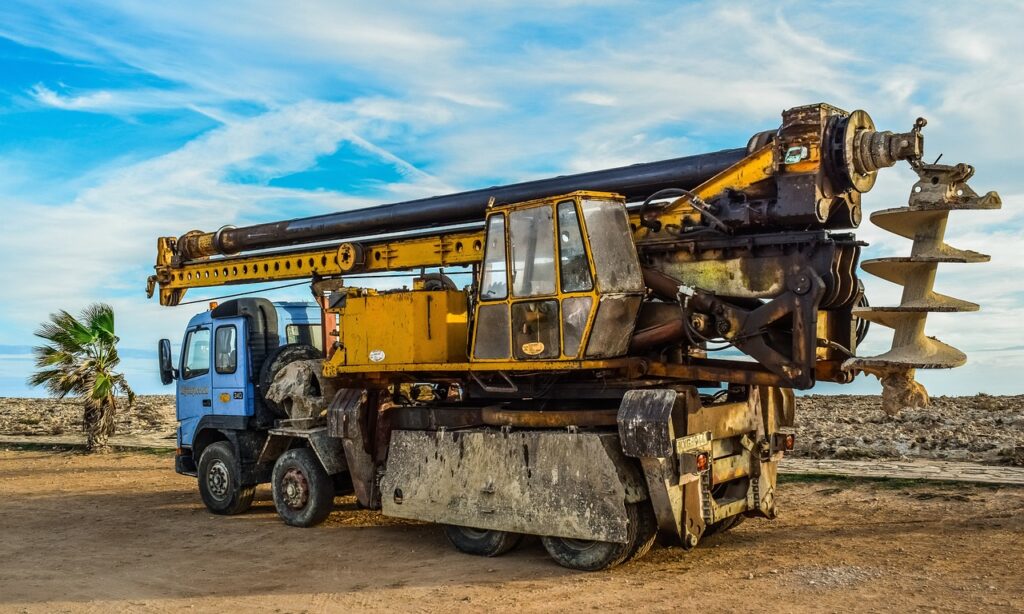
The drilling rig, support truck, water bowser and compressor arrive at your site. For most Kiambu projects, this is a 25 tonne DTH hammer rig capable of breaking through the volcanic phonolite and trachyte formations.
Drilling itself typically takes three to six days, depending on depth and the rock formations encountered. For higher altitude sites in Limuru and Lari, expect the longer end of this range.
Step 5: Casing, Screening and Grouting
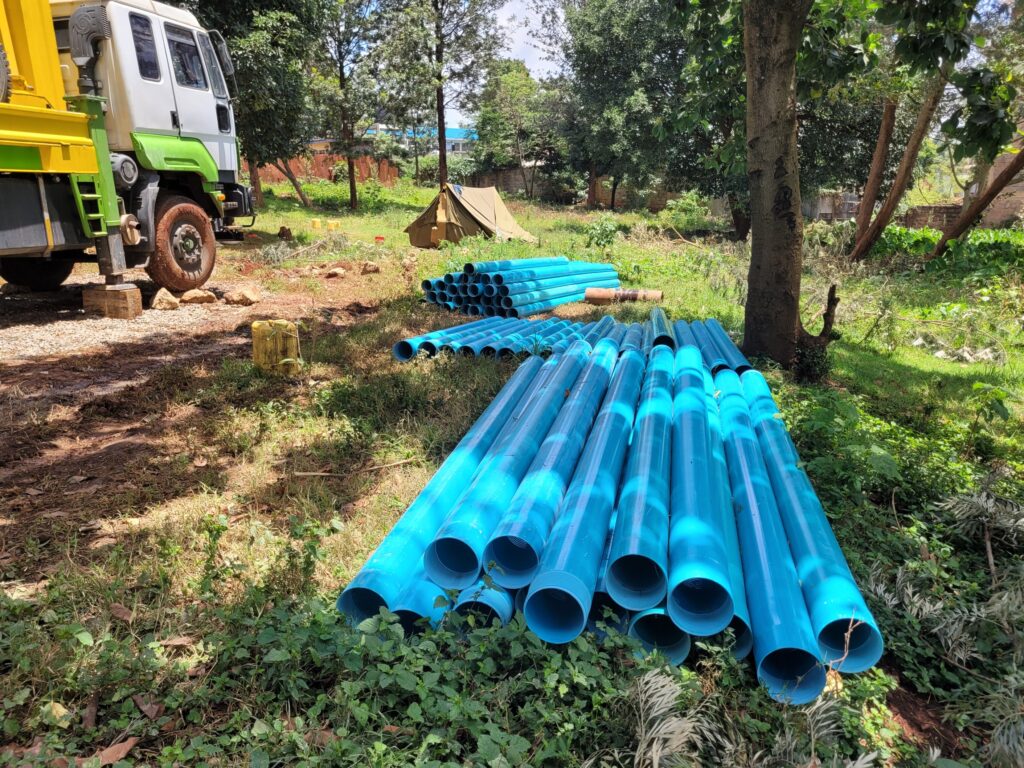
Steel casing is installed through the unstable upper weathered layer, with uPVC casing through the deeper sections. The choice between materials is detailed in our complete guide to PVC versus steel borehole casing in Kenya.
Slotted screens are precisely positioned across productive zones identified during drilling. The annular space is filled with gravel pack to filter sediment, and the upper portion is sealed with bentonite grout to prevent contamination by surface water.
This is the single most important stage for long term borehole performance. Cutting corners here causes the majority of premature borehole failures we see.
Step 6: Development and Test Pumping
The borehole is flushed, surged, and test pumped for 24 to 72 hours to confirm sustainable yield. Our detailed guide on borehole test pumping explains exactly what happens at this stage and why it matters.
The data collected includes static water level, dynamic water level, drawdown, and recovery. This determines the correct pump size and pumping schedule for the life of the borehole.
Step 7: Water Quality Testing
A water sample is sent to a certified laboratory for full analysis. The parameters tested are explained in our guide on borehole water quality testing in Kenya: 7 essential tests.
Kiambu boreholes occasionally show elevated iron or hardness, which is straightforward to treat once identified. For drinking water safety standards, refer to the World Health Organization (WHO) drinking water guidelines.
Step 8: Pump Installation and Registration
The correct submersible pump is installed at the proper depth based on test pumping data. Our overview of borehole pumps explains the different types available and which works best for your situation.
The borehole is then registered with the WRA. You receive a complete documentation pack including the registration certificate, drilling log, hydrogeological report, water analysis certificate, and operation manual.
Permits You Need in Kiambu
Drilling a borehole without proper permits is illegal under Kenya’s Water Act 2016. In Kiambu, three approvals are required before drilling can legally begin.
| Permit | Authority | Purpose |
|---|---|---|
| Authorisation to Drill | Water Resources Authority (WRA) | Confirms borehole spacing rules and abstraction limits |
| EIA Licence | National Environment Management Authority (NEMA) | Environmental impact assessment compliance |
| No Objection Letter | Kiambu County Government | Confirms no conflict with existing county water infrastructure |
In dense estates such as Ruaka, Kiambu Town, Kikuyu and parts of Ruiru, the WRA enforces strict spacing rules between boreholes. The minimum distance is typically 100 metres from any neighbouring borehole, as explained in our guide on how far apart boreholes should be in Kenya.
Without these documents, your borehole cannot be legally registered, insured, or properly valued for property purposes. The WRA actively decommissions unregistered boreholes across the country.
Common Challenges Specific to Kiambu
Kiambu’s volcanic geology and dense development create a specific set of drilling challenges. Experienced contractors plan for these from the start.
The chart below shows how often each issue appears in Kiambu projects, based on field observations. For a wider view of the issues borehole owners face, see our overview of common borehole problems and how you can fix them.
Frequency of Drilling Challenges in Kiambu
Percentage of Kiambu projects encountering each challenge
Hard Volcanic Rock
Drilling through Kiambu’s phonolite and trachyte requires DTH hammer rigs with tungsten carbide bits designed for hard formations. Lighter rotary equipment that works elsewhere in Kenya simply will not perform here.
This is why some inexperienced contractors miss target depths and either abandon boreholes or settle for inadequate shallow ones. The added difficulty also explains why borehole drilling is costly in Kenya.
Borehole Spacing in Dense Estates
In neighbourhoods like Ruaka, Kiambu Town, Kikuyu Town and parts of Ruiru CBD, existing boreholes are everywhere. WRA spacing rules mean new drilling sites must respect minimum distances from neighbours’ boreholes.
Our hydrogeological surveys map nearby boreholes and identify legal drilling positions on your plot before any permit application. This avoids costly surprises later in the process.
Limited Rig Access
Many Kiambu properties have narrow gates, tight compounds, paved areas, mature trees, or boundary walls that complicate rig access. A 25 tonne drilling rig needs real space to set up and operate safely.
We assess this carefully during the site visit and plan logistics well before drilling day. For very tight plots, read our interesting piece on whether a borehole rig can extend a hand dug well.
Iron and Hardness in Water
Some Kiambu boreholes produce water with elevated iron, manganese, or hardness, particularly in the upper highland areas. According to the World Health Organization (WHO), these parameters need to fall within specific limits for safe consumption.
We test every borehole and design appropriate treatment systems where needed. For more, see our guide on whether borehole water is safe to drink.
Borehole Drilling for Different Sectors in Kiambu
Different sectors in Kiambu have different water requirements. Here is how borehole design typically varies by use case.
Residential Homes
For a typical Kiambu family home, we design boreholes delivering 2 to 5 cubic metres per hour. This is paired with a 1.5 to 3 HP submersible pump and a 5,000 to 10,000 litre storage tank.
Our article on why your borehole needs a water tower explains why proper storage matters as much as the borehole itself. This setup serves a four to six person household comfortably for decades.
Apartment Blocks and Gated Estates
Multi unit residential developments in Ruaka, Ruiru, Kikuyu and Kiambu Town need higher yields and substantial storage. Typical specifications include 5 to 12 cubic metres per hour, with 3 to 7.5 HP pumps and 20,000 to 50,000 litre storage capacity.
Booster pumps are sometimes added for buildings above four storeys. Pressurised distribution systems ensure consistent water delivery to upper floors.
Schools and Institutions
Kiambu has hundreds of schools, colleges and training institutions that depend on reliable water. Our institutional boreholes are sized for total enrolment plus boarding, kitchen and sanitation needs.
Solar pumping systems are increasingly popular here to reduce ongoing electricity costs. See our complete guide on solar borehole pump installation in Kenya for details.
Commercial and Industrial
The Thika industrial corridor, Kahawa, the Athi River edge of Ruiru, and Tatu City require high yield boreholes. These often deliver 10 to 20 cubic metres per hour or more.
Industrial boreholes typically need larger diameter casing, three phase power, robust pumps, and dedicated water treatment. The treatment system must meet process specific quality requirements for each industry.
Agricultural and Horticultural
Dairy farms in Githunguri, tea estates in Limuru, coffee farms in Kiambaa, and horticultural operations across the county all have substantial water needs. Solar powered systems with large storage tanks of 50,000 to 100,000 litres are now standard.
Drip irrigation integration is the smart way to use your borehole water efficiently. Read our case for stopping the rain gamble with better irrigation systems in Kenya and our guide on whether borehole water is good for irrigation.
Ready to Plan Your Kiambu Borehole?
From Ruiru to Limuru, Thika to Githunguri, we deliver boreholes built to last decades.
Choosing the Right Drilling Contractor in Kiambu
The contractor you choose decides whether your Kiambu borehole lasts 40 years or fails in 18 months. Cheap quotes almost always come with hidden costs, as we expose in our article on the hidden cost of cheap borehole drilling.
Common shortcuts include undersized casing that collapses, skipped surveys leading to dry holes, missed permits that risk decommissioning, and no test pumping. For a full breakdown of selection criteria, read our piece on how to choose the best borehole drilling company in Nairobi, which applies equally to Kiambu.
Use this checklist before signing any contract.
- ✅ Licensed by the Water Resources Authority (WRA) with current credentials
- ✅ Works with WRA licensed hydrogeologists for the survey
- ✅ Provides a written, itemised quotation covering survey, permits, drilling, casing, development, test pumping, water testing, pump and commissioning
- ✅ Can show you drilling logs and registration certificates from recent Kiambu projects
- ✅ Has specific Kiambu experience across the volcanic, highland and basement zones
- ✅ Uses DTH hammer rigs suitable for Kiambu’s hard rock
- ✅ Offers maintenance contracts after installation
- ✅ Provides written warranties on workmanship
- ✅ Has insurance cover for the drilling crew and your property
- ✅ Provides complete documentation handover at project completion
Borehole Maintenance and Lifespan in Kiambu
A properly drilled Kiambu borehole will deliver clean water for 30 to 50 years. But like any infrastructure investment, it needs basic care to perform at its best.
The submersible pump is the most service intensive component, typically needing replacement every 7 to 12 years. This depends on water quality and usage intensity.
Annual maintenance should include a water quality test, inspection of the pump and control panel, and checking the static and dynamic water levels. The water level data tells you if the aquifer is being over extracted.
Every five to seven years, the borehole benefits from professional flushing and surging to remove sediment build up and restore peak yield. Look out for the signs your borehole needs flushing and read our complete guide on borehole flushing in Kenya.
If your borehole produces discoloured water after maintenance, that is usually a temporary condition explained in our guide on whether borehole water will clear after drilling. Our long term maintenance contracts handle scheduled care so you never have to think about it.
Frequently Asked Questions About Borehole Drilling in Kiambu
How deep are boreholes in Kiambu?
Most successful new boreholes in Kiambu reach 150 to 320 metres depending on location and elevation. Lower altitude areas like Ruiru, Juja and Thika typically need 150 to 230 metres, while higher altitude areas like Limuru and Lari may need 240 to 320 metres.
How long does borehole drilling take in Kiambu?
From the first survey to commissioning, expect 4 to 10 weeks total. Actual drilling usually takes 3 to 6 days, with deeper highland boreholes at the longer end of that range.
Do I need permits to drill a borehole in Kiambu?
Yes. Three approvals are required before drilling: WRA authorisation, a NEMA EIA licence, and a Kiambu County no objection letter. A reputable drilling company handles all three on your behalf.
Can I drill a borehole in a small Kiambu compound?
Often yes. A 25 tonne drilling rig needs real access, but our site assessment confirms what is possible at your specific location.
Tight compounds in Kiambu Town, Kikuyu, Ruaka and Ruiru CBD may require additional planning but most are workable with the right approach.
Is borehole water in Kiambu safe to drink?
It depends on the borehole and the aquifer. Water from the deeper Basement aquifers is generally good quality, but every borehole needs proper laboratory testing.
Treatment systems address any issues identified during testing. For more, see our guide on whether borehole water is safe to drink.
Will a borehole increase my Kiambu property value?
Yes, especially in areas with chronic water supply issues like Ruaka, Kiambu Town and parts of Ruiru. A properly registered, fully documented borehole adds meaningful value to most Kiambu properties.
Can I drill a borehole in an apartment block or gated estate?
Yes, with proper planning and consent from the body corporate or estate management. Apartment block boreholes typically need higher yield and larger storage to serve multiple units.
How long does a Kiambu borehole last?
A properly drilled, properly cased, and properly maintained borehole in Kiambu will reliably produce water for 30 to 50 years. The submersible pump typically needs replacement every 7 to 12 years.
What if my Kiambu borehole runs dry or yields drop?
Shallow boreholes drilled into over extracted upper layers are most at risk. New deep boreholes drilled with proper hydrogeological surveys very rarely run dry.
If yields drop on an existing borehole, professional flushing and surging can often restore performance significantly. Our guide on borehole flushing covers this in detail.
Do you drill boreholes for industrial use in Thika and Ruiru?
Yes. We have substantial experience designing and drilling high yield industrial boreholes for factories, food processors, warehouses and logistics facilities across the Thika and Ruiru industrial corridors.
Can I have solar powered borehole pumping in Kiambu?
Absolutely. Solar pumping systems work very well in Kiambu and dramatically reduce ongoing electricity costs.
We design hybrid systems (solar plus grid) for the most reliable performance, particularly for agricultural and remote sites. See our solar borehole pump installation guide for details.
Which sub counties of Kiambu do you serve?
We serve all 12 sub counties of Kiambu. This includes Ruiru, Juja, Thika, Kiambu, Kiambaa, Kikuyu, Kabete, Limuru, Lari, Githunguri, Gatundu North and Gatundu South.
Ready to Drill Your Borehole in Kiambu?
Bonvic Drilling has completed boreholes across every sub county of Kiambu. From the industrial belt of Thika and Ruiru to the dairy farms of Githunguri, the tea growing highlands of Limuru, and the dense residential estates of Ruaka, Kikuyu and Kiambu Town, we know this county.
We understand the geology, the permits, the licensed surveyors, and the practical realities of working in Kiambu. Our complete 2026 borehole drilling guide covers the national context, while this article focuses on what makes Kiambu unique.
Every project starts the same way. A free site assessment at your property, an honest conversation about your water needs, and a clear plan from there.
For context on borehole services we offer in nearby counties, see our guides on borehole drilling in Nairobi and borehole drilling in Kajiado.
Get Your Free Kiambu Site Assessment Today
Speak to a licensed Bonvic Drilling engineer. No obligation, no pressure.
Sources: Kenya National Bureau of Statistics (KNBS); Water Resources Authority (WRA); National Environment Management Authority (NEMA); Kiambu County Government; World Health Organization (WHO).