Quick answer: for most apartment blocks and rental buildings in Kenya, a borehole is the most reliable and, over time, the cheapest source of water. Expect drilling at KES 6,500 to KES 7,200 per metre, plus KES 50,000 for the hydrogeological survey and about KES 85,000 for permits. In Nairobi most new boreholes go 150 to 300 metres deep. The best time to drill is while the building is still under construction.
Empty taps are one of the fastest ways to lose tenants. This guide helps landlords and developers size, budget and plan a borehole that keeps a whole building supplied.
Why Landlords and Developers Drill Boreholes
- Reliable supply. County supply and rationing schedules are out of your control. A borehole is not.
- Lower running costs. Once a solar pump is in, water costs very little each month compared with bowser deliveries.
- Easier letting. “Borehole water, no rationing” is one of the strongest lines in a rental listing.
- Higher building value. A reliable water supply makes units easier to sell and finance.
Drill During Construction, Not After
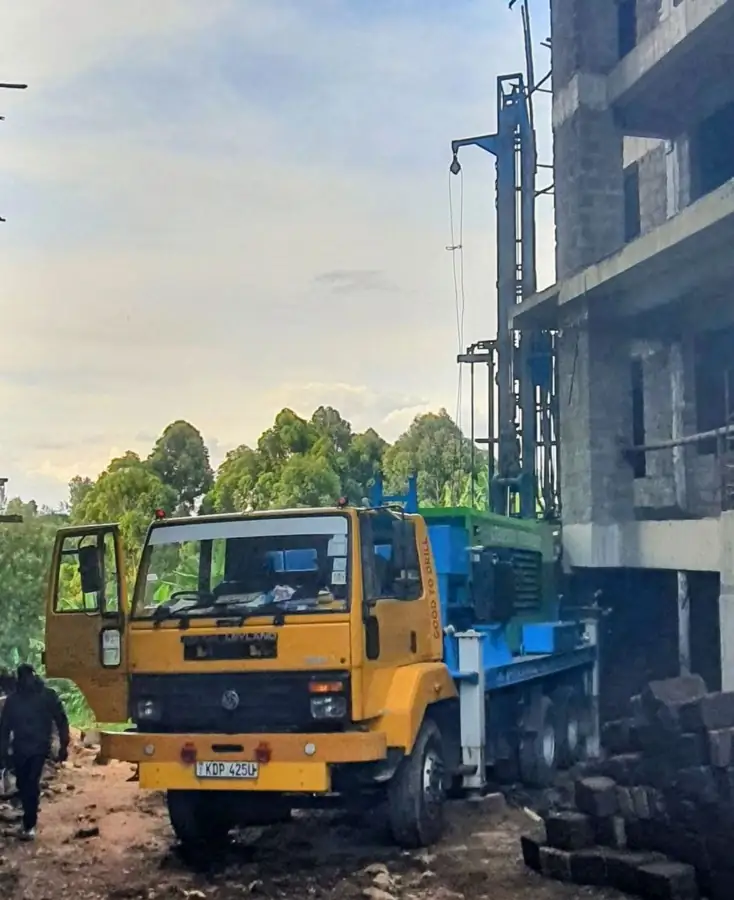
A drilling rig is a large, heavy truck. Before the compound is paved, fenced and landscaped, it can reach the best drilling point easily. Drilling early also lets your architect plan the pump house, the tank or tower and the pipework into the building instead of fitting them in later. If your block is already finished, a borehole is still possible, but the drilling point is limited to where the rig can fit.
How Much Water Does an Apartment Block Need?
Size the borehole from your daily demand. A simple planning method:
Units × people per unit × litres per person per day = litres per day
For example, a 40 unit block with 3 people per unit, planned at 100 litres per person per day, needs about 12,000 litres a day. A borehole yielding 2 cubic metres per hour (2,000 litres per hour) supplies that in about six hours of pumping. Your actual planning figure depends on the type of units and tenants, so treat 100 litres as a starting assumption, not a rule.
The hydrogeological survey gives an anticipated yield before drilling, and test pumping confirms the real yield afterwards. If one borehole cannot meet demand, a second borehole or larger storage fills the gap. Boreholes also need enough distance from each other; see how far apart boreholes should be in Kenya.
What a Borehole for an Apartment Block Costs
| Item | Cost (KES) |
|---|---|
| Hydrogeological survey | 50,000 |
| Permits (WRA, NEMA and county) | About 85,000 |
| Drilling 250 m at 7,200 per metre (casing, gravel pack, development, test pumping and water analysis included) | 1,800,000 |
| Total before pump, storage and treatment | About 1,935,000 |
Pump, solar and storage are quoted after test pumping, because they depend on the yield and on how high the water has to be lifted. For comparison, a community solar pumping system we quoted in Homa Bay County in 2026 came to KES 1.2 million. See the full borehole drilling cost in Kenya breakdown, or plan storage with our guide on why your borehole needs a water tower.
Payback: When Does the Borehole Pay for Itself?
Work it out with your own numbers:
Total borehole cost ÷ monthly water spend = months to pay back
For example, if a building spends KES 80,000 a month on bowser water and the borehole, pump, solar and storage come to KES 3 million in total, the borehole pays for itself in about 38 months, a little over three years. After that, most of that monthly spend stays in your pocket. A well built borehole lasts 30 to 50 years. For a detailed comparison with mains supply, see borehole vs county water.
Water Quality and Treatment
Groundwater in parts of Nairobi carries high fluoride, and some areas have salty or iron rich water. Every Bonvic borehole includes a water quality analysis, so you know before tenants drink it whether treatment is needed. The World Health Organization recommends keeping fluoride below 1.5 mg per litre in drinking water. Our guide to borehole water quality testing in Kenya covers what is tested.
Permits for Apartment Boreholes
An apartment borehole needs the same approvals as any other: authorisation from the Water Resources Authority, environmental approval from NEMA and county approval, under the Water Act 2016. The permit category depends on how much water you plan to abstract, which is another reason to size demand properly at the start. Nairobi has seen a rapid rise in boreholes in residential estates, as this report on Nairobi estates describes, so getting the permits right protects your investment.
Sharing a Borehole with Neighbouring Buildings
If neighbouring plots or blocks have the same problem, sharing one borehole can cut the cost for everyone. It needs clear agreements on cost sharing, maintenance and metering. See shared boreholes for estates in Kenya.
Frequently Asked Questions
Is a borehole worth it for a rental building in Kenya?
For most buildings, yes. It gives tenants a reliable supply, cuts monthly water costs and usually pays for itself within a few years compared with buying water.
Can one borehole supply a whole apartment block?
Often yes, depending on the yield. A borehole yielding 2 cubic metres per hour supplies about 12,000 litres in six hours of pumping, enough for a 40 unit block at 100 litres per person per day.
How deep are apartment boreholes in Nairobi?
Most new boreholes in Nairobi are between 150 and 300 metres deep. The survey gives the recommended depth for your plot.
When is the best time to drill a borehole for an apartment?
During construction, before the compound is paved and fenced, so the rig can reach the best drilling point.
Do I need permits for an apartment borehole?
Yes. You need WRA authorisation, NEMA approval and county approval before drilling.
WhatsApp the location and the number of units to 0727 666 444 and we will tell you the expected depth, the yield you need and a cost range for your project.