Quick answer: a shallow well is dug by hand, usually less than 30 metres deep, and costs less to make. A borehole is drilled by machine, often 60 to 300 metres deep in Kenya, cased and sealed, and gives far more water through the dry season. For a single home near a lake or river a protected well can work. For farms, schools, estates and most of Nairobi, Kiambu and the dry counties, a borehole is the reliable choice.
Every week someone asks us whether they should dig a well or drill a borehole. The honest answer depends on how much water you need, where your plot is and whether the water will be drunk.
This guide compares the two on depth, yield, water quality, lifespan and cost, with a decision helper that gives you an answer for your plot in a few clicks.
Shallow well or borehole? Decision helper
Shallow well or borehole? Decision helper
Answer five questions about your plot. We tell you which option fits and what to check first.
Shallow well vs borehole: key differences
| Shallow well (hand dug) | Borehole (machine drilled) | |
|---|---|---|
| Depth | Usually under 30 m | Often 60 to 300 m in Kenya |
| Width | 1 to 2 m | 10 to 25 cm |
| How it is made | Dug by hand, lined with stones, bricks or rings | Drilled by a rig, cased with PVC or steel |
| Water source | Upper water table | Deeper aquifers |
| Dry season | Often drops or dries up | Usually steady if sited well |
| Contamination risk | High if open or near latrines | Low when cased and sealed |
| Pumping | Bucket, hand pump or small surface pump | Submersible pump, often solar |
| Typical use | One home, small garden | Homes, farms, schools, estates, businesses |
Depth and the water table
A shallow well taps the upper water table, the water that collects in soil and loose rock close to the surface. That water rises in the rains and falls in the dry season, and it is the first to fail in a drought.
A borehole goes through that layer into deeper aquifers that are recharged over a much larger area. Our borehole depth by county guide shows typical depths: 150 to 320 metres in Kiambu, 80 to 300 in Kajiado and 60 to 180 in much of the central highlands.
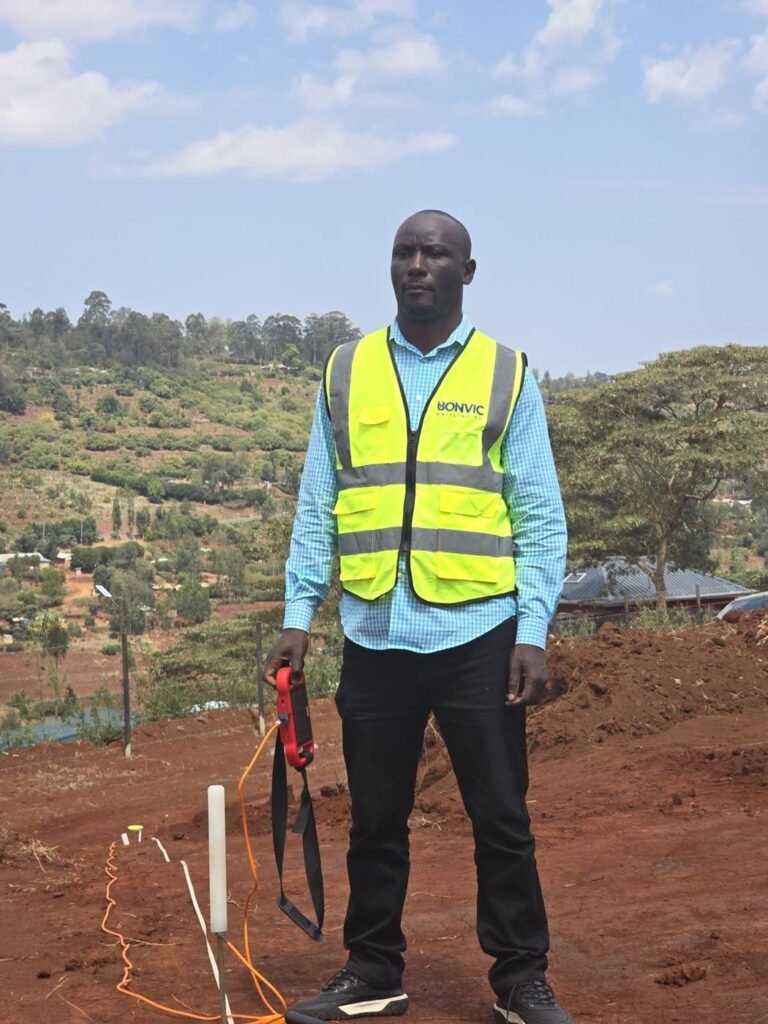
Before you choose, a survey tells you whether shallow water exists at all. See what a hydrogeological survey is.
How much water each one gives
A hand dug well collects water slowly through its walls and floor, which is usually enough for a home but not for cows, crops or a school. A borehole draws from a larger aquifer and is test pumped to give a measured safe yield.
- Shallow well: often a few hundred to a few thousand litres a day, less in the dry season.
- Borehole: commonly thousands of litres an hour where the aquifer is good. See what is a good borehole yield.
Use the calculator below to estimate how much water your home or farm needs in the dry season.
How much water does your farm or home need?
Enter what you have. We estimate your daily water need in the dry season and the borehole yield and tank size to aim for.
Water quality and safety
This is where boreholes win clearly. A shallow well sits close to latrines, septic tanks, animal pens and runoff, and an open top lets in dirt, insects and small animals.
- Shallow wells need a lined shaft, a raised concrete cover, a hand pump instead of buckets and at least 30 metres from latrines.
- Boreholes are cased and finished with a sanitary seal and concrete apron, which keeps surface water out of the deeper aquifer.
- Both should be tested before drinking and every year after. See borehole testing in Kenya.
Deep water can carry natural minerals such as fluoride or iron in some areas. See fluoride in borehole water.
Cost compared
A shallow well is cheaper to dig because it is shallow and done by hand. Local diggers usually price it per foot or per metre, plus the lining, cover and pump.
A borehole costs more up front. With Bonvic, air drilling costs KES 6,500 to 7,200 per metre including casing, gravel packing, test pumping and a water analysis, plus about KES 135,000 for the survey and permits.
| Borehole depth | Drilling | Survey and permits | Total before pump |
|---|---|---|---|
| 60 m | KES 390,000 to KES 432,000 | KES 135,000 | KES 525,000 to KES 567,000 |
| 100 m | KES 650,000 to KES 720,000 | KES 135,000 | KES 785,000 to KES 855,000 |
| 150 m | KES 975,000 to KES 1,080,000 | KES 135,000 | KES 1,110,000 to KES 1,215,000 |
| 200 m | KES 1,300,000 to KES 1,440,000 | KES 135,000 | KES 1,435,000 to KES 1,575,000 |
BLACK NOVEMBER 2026 OFFER
Hydrogeological survey KES 40,000. Drilling KES 6,500 per metre with PVC casing or KES 6,700 per metre with steel casing, for jobs booked by 30 November 2026.
See the offer and estimate your total or call 0727 666 444.
Compare cost per litre over ten years, not just the first bill. A well that dries up every February, or needs deepening every few years, is not cheap. See borehole drilling cost in Kenya and how to pay for a borehole.
When a shallow well makes sense
- Your plot is near a lake, river or swamp and neighbours have water all year.
- You need water for one household, not livestock or irrigation.
- Latrines and septic tanks are well over 30 metres away and uphill is clean.
- You can line it, cover it, fit a hand pump and test the water.
When you need a borehole
- You live on high ground such as Nairobi, Kiambu, Murang'a or Nyandarua, where water is deep.
- You are in a dry county where shallow wells fail in the dry season.
- You need water for a farm, dairy, school, church, estate or business.
- You want clean drinking water on a plot close to neighbours' latrines.
See our county guides for Nairobi, Kiambu, Machakos and Nyandarua.
Can a hand dug well become a borehole?
Sometimes a rig can drill through the floor of an old well to reach deeper water. The risk is the open shaft above, which can let dirty water run down into the new hole.
We explain when it works in can a borehole rig extend a hand dug well. Often a new borehole a few metres away is cleaner and simpler.
Planning a borehole in your area?
WhatsApp us your location (village and sub county). We will tell you the expected depth and a cost range for your area. Drilling across Kenya since 2010.
WhatsApp 0727 666 444Call 0797 000 555Frequently Asked Questions
What is the difference between a well and a borehole?
A well is usually dug by hand, about 1 to 2 metres wide and rarely deeper than 30 metres. A borehole is drilled by machine, 10 to 25 centimetres wide, lined with casing and often 60 to 300 metres deep, so it reaches deeper, more reliable water.
Which is cheaper, a shallow well or a borehole?
A shallow well costs less to dig, but it gives less water and often dries up or gets contaminated. A borehole costs more up front and usually gives far more water for many years, so the cost per litre is often lower.
How deep is a shallow well in Kenya?
Most hand dug wells in Kenya are under 30 metres deep. Where the water table is shallow, near lakes, rivers and some coastal areas, water may be found within 10 to 20 metres.
Can you turn a hand dug well into a borehole?
Sometimes. A rig can drill through the bottom of an existing well, but the open well above can let dirty water in. In many cases a new borehole drilled nearby is cleaner and better value.
Is borehole water safer than well water?
Usually, yes. A borehole is cased and sealed at the top, so surface water and latrine waste are kept out. Shallow wells are open to contamination, so they need a good cover, lining and regular testing.
Do I need a permit for a well in Kenya?
The Water Resources Authority regulates groundwater use from both wells and boreholes. Check with us or your WRA office before you dig or drill.
The Bonvic team. WhatsApp 0727 666 444 or call 0797 000 555.