Quick answer: most boreholes in Tharaka Nithi County are drilled to 60 to 200 metres, and the dry Tharaka lowlands usually need the deeper end. With Bonvic, air drilling costs KES 6,500 to 7,200 per metre including casing, gravel packing, test pumping and a water analysis. Add about KES 135,000 for the survey and permits, so a 180 metre borehole comes to roughly KES 1,305,000 to 1,431,000 before the pump.
Tharaka Nithi stretches from Chogoria and Chuka on the slopes of Mount Kenya down to the hot lowlands of Marimanti, Gatunga and Mukothima. Up the mountain, water is easier to find. Down in Tharaka, dry rivers and long walks for water are common in a drought.
This guide covers depth, siting, water safety, costs and permits for a borehole in Tharaka Nithi, with a contamination risk check and a cost estimator.
Why boreholes matter in Tharaka Nithi
Tharaka Nithi had 393,177 people in the 2019 census (KNBS via City Population). More than a third live in the semi arid Tharaka North, Tharaka South and Igambang’ombe sub counties.
The county has drilled and rehabilitated boreholes in its semi arid areas, but frequent breakdowns and weak maintenance have been a problem, according to the Council of Governors’ Maarifa Centre. Many homes and trading centres still lack enough water.
A private or community borehole, properly sited and maintained, gives reliable water through the dry season. See community borehole projects and our borehole maintenance checklist.
How deep is the water in Tharaka Nithi?
Our borehole depth by county guide puts Tharaka Nithi at 60 to 200 metres. A 2026 hydrogeological survey we priced in the county recommended 180 metres, which is typical for the drier zones.
| Where your plot is | What to expect | Plan for |
|---|---|---|
| Chogoria and the upper slopes | Volcanic rock, often the shallower end | Steep, muddy access in the rains |
| Chuka and Meru South | Moderate depths, varying with the rock | Distance from septic tanks on town plots |
| Kathwana and Igambang’ombe | Mixed ground; depth varies site by site | A survey to find the best fracture |
| Marimanti, Gatunga and the Tharaka lowlands | Hard basement rock, often 150 metres or more | A budget for the deeper end and a large tank |
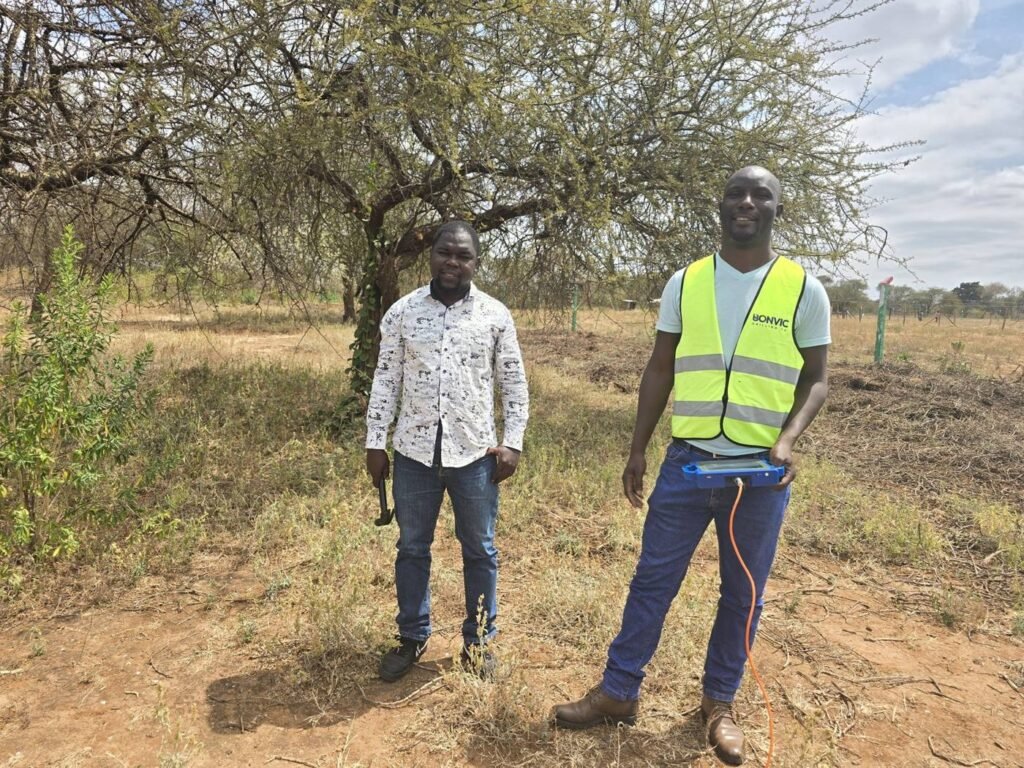
Drilling in the dry lowlands
In Tharaka, water sits in cracks and weathered zones in hard basement rock. These zones are narrow and refill slowly, so siting decides success.
- Never skip the survey. A geophysical survey finds the fractures that hold water. Drilling on a guess is the biggest cause of dry holes.
- Expect modest yields. Many lowland boreholes give enough for homes, schools and livestock, but less for large irrigation.
- Pump to the safe yield. A pump that is too big drains the borehole. Test pumping sets the right size; see borehole test pumping.
- Store water. Pump slowly through the day into a tank. Use our water tank size calculator.
- Plan for drought. Read borehole yield during drought.
Our guide to drilling a borehole during a drought explains why the dry season can be a good time to drill.
Keeping borehole water safe
A Chuka University study sampled 36 boreholes in Maara, Igambang’ombe and Tharaka in 2019. It found faecal coliform bacteria above the WHO guideline in the boreholes surveyed, and linked the contamination to nearby toilets, animal waste and surface runoff.
The good news is that most contamination comes in from the top, and a well built borehole keeps it out. Every Bonvic borehole has casing, a gravel pack and a sanitary seal, and includes a water analysis.
- Site the borehole away from latrines, ideally uphill of them.
- Seal the top. A sanitary seal, a raised concrete apron and a locked cap stop runoff going down the casing.
- Keep animals off the wellhead. Pipe water to troughs away from the borehole.
- Test every year and after flooding. See how often to test borehole water.
- Disinfect after repairs, and treat drinking water until a test shows it is clean.
Borehole contamination risk check
Borehole contamination risk check
For a new or existing borehole. Answer five questions and we show the risk of bacteria getting in and what to fix first.
Read is borehole water safe to drink and the hidden dangers in borehole water for more.
Tharaka Nithi sub counties at a glance
Tharaka Nithi has five sub counties (KNBS 2019 figures via City Population). The notes are a general guide; your survey decides the drilling point.
| Sub county | Population (2019) | What to expect |
|---|---|---|
| Maara | 114,894 | Chogoria and the upper slopes of Mount Kenya. Wetter ground; plan rig access on steep roads. |
| Meru South | 91,080 | Chuka town and its surroundings. Many plots want a backup to piped supply. |
| Igambang'ombe | 53,210 | Kathwana, the county headquarters, and the middle zone. Depth varies with the rock. |
| Tharaka South | 75,250 | Marimanti and Chiakariga. Semi arid lowlands where a borehole is often the only reliable water. |
| Tharaka North | 58,345 | Gatunga and Mukothima. Dry lowlands; careful siting matters most here. |
Borehole drilling cost in Tharaka Nithi (2026)
You pay per metre, so depth is the biggest factor. These figures use our 2026 air drilling rates, which include casing, gravel packing, well development, test pumping and a water quality analysis.
| Depth | Drilling | Survey and permits | Total before pump |
|---|---|---|---|
| 100 m | KES 650,000 to KES 720,000 | KES 135,000 | KES 785,000 to KES 855,000 |
| 150 m | KES 975,000 to KES 1,080,000 | KES 135,000 | KES 1,110,000 to KES 1,215,000 |
| 180 m | KES 1,170,000 to KES 1,296,000 | KES 135,000 | KES 1,305,000 to KES 1,431,000 |
| 200 m | KES 1,300,000 to KES 1,440,000 | KES 135,000 | KES 1,435,000 to KES 1,575,000 |
BLACK NOVEMBER 2026 OFFER
Hydrogeological survey KES 40,000. Drilling KES 6,500 per metre with PVC casing or KES 6,700 per metre with steel casing, for jobs booked by 30 November 2026.
See the offer and estimate your total or call 0727 666 444.
The pump, solar system and tank are sized after test pumping. See how much borehole drilling costs in Kenya and how to pay for a borehole in Kenya.
Borehole cost estimator for Tharaka Nithi
Borehole cost estimator for Tharaka Nithi
Most Tharaka Nithi boreholes fall between 60 and 200 metres, and lowland sites are often at the deeper end. Move the slider to your expected depth and pick what the water is for.
Based on Bonvic air drilling rates of KES 6,500 to 7,200 per metre from 2026 client quotes. Your exact depth and price are confirmed in writing after the survey.
Permits in Tharaka Nithi
Tharaka Nithi falls in the Water Resources Authority's Tana Basin Area. You also need NEMA approval and county consent, and where a water company's pipes reach your plot, a no objection letter from that company.
We handle the paperwork for about KES 85,000. See borehole permits in Kenya for every step.
How a Tharaka Nithi borehole project runs
- Location on WhatsApp. Your village, sub county and what the water is for.
- Hydrogeological survey. Finds the water bearing fractures and the expected depth.
- Permits. WRA, NEMA and county approvals.
- Drilling. Air drilling through the hard rock.
- Casing, gravel pack and sanitary seal. Keeps surface water and bacteria out.
- Test pumping and water analysis. Safe yield and water quality, in writing.
- Pump, solar and tank. Sized from the test results. See solar borehole pump installation.
Neighbouring counties: Meru, Embu and Kitui.
Planning a borehole in Tharaka Nithi?
WhatsApp us your location (village and sub county). We will tell you the expected depth and a cost range for your area. Drilling across Kenya since 2010.
WhatsApp 0727 666 444Call 0797 000 555Choosing a driller? Use our eight checks to find the best borehole drilling company in Kenya for your project, with 2026 prices and red flags to avoid.
Frequently Asked Questions
How deep are boreholes in Tharaka Nithi?
Most boreholes in Tharaka Nithi are drilled to 60 to 200 metres, according to our borehole depth by county guide. A 2026 survey we priced in the county recommended 180 metres, so budget for the deeper end in the dry lowlands.
How much does borehole drilling cost in Tharaka Nithi?
With Bonvic, air drilling costs KES 6,500 to 7,200 per metre including casing, gravel packing, test pumping and a water analysis. Add about KES 135,000 for the survey and permits. A 180 metre borehole comes to roughly KES 1,305,000 to 1,431,000 before the pump.
Is borehole water in Tharaka Nithi safe to drink?
Not always without treatment. A Chuka University study of 36 boreholes in the county found faecal coliform bacteria above WHO limits in the boreholes surveyed, linked to nearby toilets, animal waste and runoff. A sealed wellhead, distance from latrines and regular testing protect your water.
Why do some boreholes in Tharaka dry up?
In the lowlands, water sits in cracks in hard rock that refill slowly. A borehole sited without a survey, or pumped harder than its safe yield, can fall dry in a long drought. Test pumping and the right pump size prevent this.
Which WRA office handles Tharaka Nithi borehole permits?
Tharaka Nithi falls in the Water Resources Authority Tana Basin Area. We prepare and submit the permit file for you after the survey.
The Bonvic team. WhatsApp 0727 666 444 or call 0797 000 555.