Quick answer: with drip irrigation, every 1 m³ per hour of safe borehole yield, pumped for 8 hours, waters about a third of an acre of vegetables through the dry season. So a 3 m³/h borehole covers about 1 acre, and a 10 m³/h borehole about 3.5 acres.
Sprinklers and furrows need more water for the same crop, so the same borehole covers less ground. Use the calculator below to see the figure for your yield, crop and county.
How many acres can your borehole irrigate?
Enter your yield from the test pumping report. The result updates as you type.
Planning estimate for the driest weeks, with no rain. It uses peak crop water use in millimetres a day, 1 mm on an acre = 4,047 litres, and typical system efficiencies of 90% (drip), 75% (sprinkler) and 60% (furrow). Your agronomist and our test pumping report refine the final design.
How to Work Out Your Borehole Irrigation Area
Three numbers decide how many acres a borehole can water. The first is how much water it can give each day. The second is how much water your crop uses. The third is how much your irrigation system wastes.
1. Water available each day
Your test pumping report gives the safe yield in cubic metres per hour. Multiply it by the hours you pump. A solar pump usually runs about 6 to 8 hours on a sunny day.
Then take away what the home, staff and animals need. What is left is your irrigation water.
2. How much water the crop uses
Crop water use is measured in millimetres a day, just like rain. In most of central and eastern Kenya, a growing crop uses about 4 to 6 mm a day in the dry season, and more in hot, windy areas such as Machakos and Kajiado.
One millimetre over one acre is 4,047 litres. So a crop using 5 mm a day needs about 20,000 litres on every acre, every day, before any losses. The method follows the FAO guidelines on crop water requirements.
3. How much the system wastes
No system puts every drop at the roots. FAO irrigation training manuals give typical field application efficiencies of about 90% for drip, 75% for sprinklers and 60% for surface irrigation such as furrows. See the FAO manual on irrigation scheduling.
Put together, an acre of vegetables on drip needs about 22.5 m³ a day at 5 mm. On furrow it needs about 34 m³ for the same crop.
Acres You Can Irrigate by Borehole Yield
This table assumes 8 hours of pumping, a crop using 5 mm a day and no rain. Nothing is held back for the home.
| Safe yield | Water per day | Drip (acres) | Sprinkler (acres) | Furrow (acres) |
|---|---|---|---|---|
| 1 m³/h | 8 m³ | 0.4 | 0.3 | 0.2 |
| 2 m³/h | 16 m³ | 0.7 | 0.6 | 0.5 |
| 3 m³/h | 24 m³ | 1.1 | 0.9 | 0.7 |
| 5 m³/h | 40 m³ | 1.8 | 1.5 | 1.2 |
| 8 m³/h | 64 m³ | 2.8 | 2.4 | 1.9 |
| 10 m³/h | 80 m³ | 3.6 | 3.0 | 2.4 |
Notice how much the system matters. The same 5 m³/h borehole waters about 1.8 acres on drip but only about 1.2 acres on furrow.

Choosing an Irrigation System for a Borehole
- Drip: the best choice for vegetables, fruit trees and greenhouses. It needs a filter, because sand and iron block the emitters.
- Sprinkler: good for napier, lucerne, pasture and closely planted field crops. It loses some water to wind and heat.
- Furrow or flood: cheap to set up but wasteful. It suits flat land with plenty of water, which few borehole farms have.
Our guide to the best irrigation systems in Kenya compares each option in more detail.
Why You Need a Tank Between the Borehole and the Farm
Pumping straight into drip lines rarely works well. The pump runs only when the sun shines, while crops are best watered early in the morning.
The usual setup pumps into a tank or water tower during the day. The tank then feeds the lines by gravity or with a small booster pump. Size the tank to hold at least one full day of pumping.
Our pump and tank size calculator helps you match the tank to your demand.
Solar Pumping for Irrigation
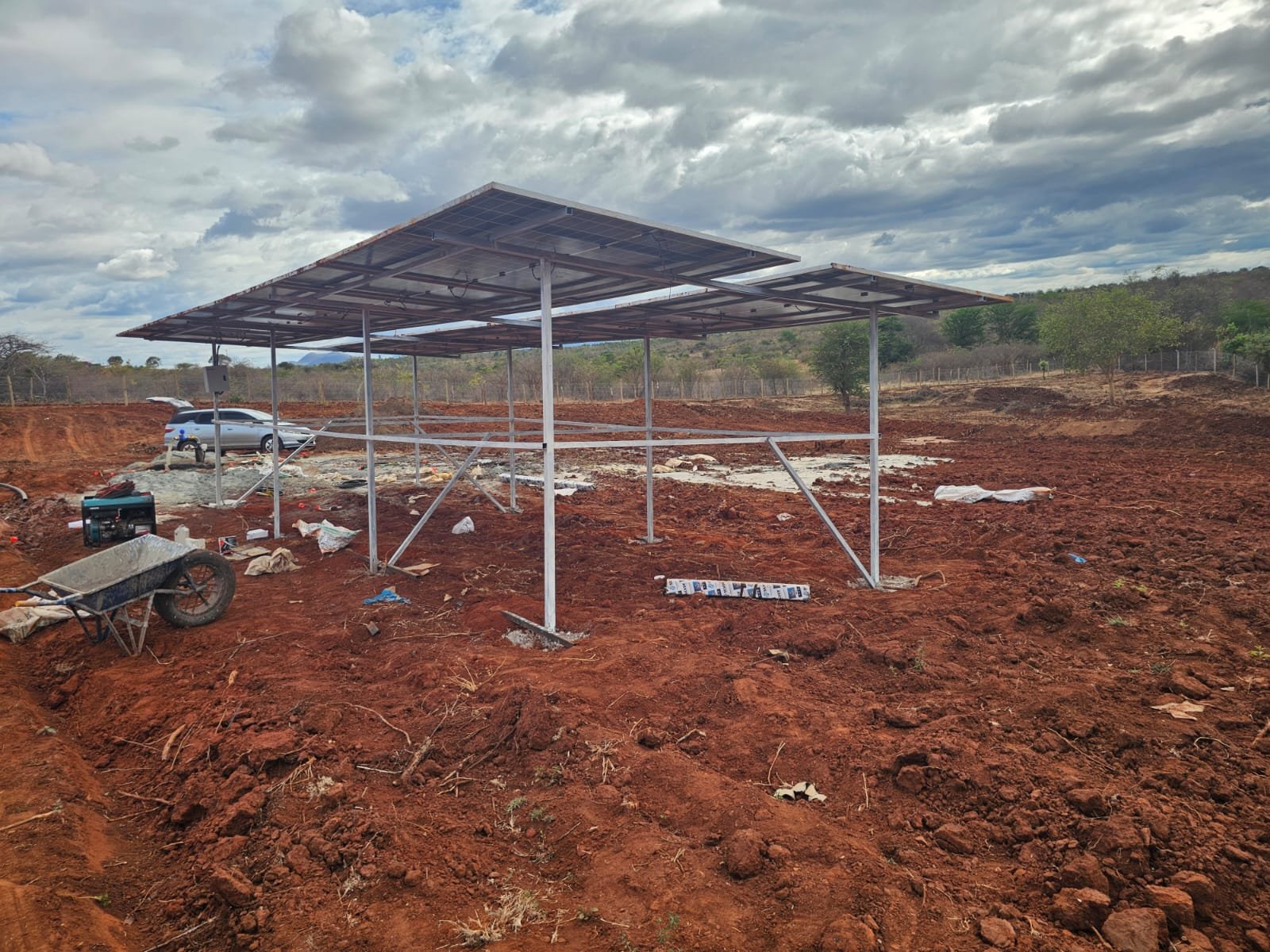
Most new irrigation boreholes in Kenya now run on solar. There is no monthly power bill, which matters when you pump every day of the dry season.
The pump must match both the yield and the total lift. Our borehole pump sizing guide works out flow, head and kW, and our solar borehole pump installation page explains the full system.
Check Your Water Before You Buy Drip Lines
Borehole water is good for most crops, but test it first. Salty water slowly damages soil and burns sensitive crops, while iron and sand clog emitters.
A lab test tells you which filter and which crops make sense. Read is borehole water good for irrigation and borehole water testing labs and prices before you plant.
Steps to Plan a Borehole Irrigation Project
- Decide the crop and the area you want to irrigate.
- Get a hydrogeological survey to choose the drilling point and expected depth.
- Drill the borehole and run a proper test pump to find the safe yield.
- Use the yield to size the irrigated area, the pump and the solar array.
- Build storage for at least one day of pumping.
- Lay out the drip or sprinkler lines with filters and valves for each block.
- Plant in stages, starting with the area your water can support all year.
Common Mistakes on Borehole Farms
- Planting more acres than the borehole can water in February, the hottest dry month in much of Kenya.
- Pumping harder than the safe yield, which pulls the water level down to the pump.
- Skipping filters on drip lines, then replacing blocked emitters every season.
- Choosing a pump from a shop before the test pumping results are in.
Planning an irrigation borehole?
Send us your location and the area you want to farm. We will tell you the expected depth in your county and what yield it usually gives.
WhatsApp 0727 666 444Call usRelated: Borehole drilling in Eldoret and Uasin Gishu County
Frequently Asked Questions
How many acres can one borehole irrigate in Kenya?
It depends on the yield. With drip irrigation and 8 hours of pumping, each cubic metre per hour of safe yield waters about a third of an acre of vegetables in the dry season. A 3 m³/h borehole covers about 1 acre and a 10 m³/h borehole about 3.5 acres.
Is drip or sprinkler better for a borehole farm?
Drip is usually better because about 90% of the water reaches the roots, against about 75% for sprinklers and 60% for furrows. Sprinklers still suit pasture, napier and closely planted field crops.
Can a solar borehole pump run an irrigation system?
Yes. Most new borehole irrigation in Kenya runs on solar. The pump fills a tank or water tower during the day and the crops are watered from the tank, often by gravity, early in the morning.
What borehole yield do I need for one acre of drip irrigation?
For one acre of vegetables in a warm area you need about 22 to 25 m³ a day in the dry season. That is roughly 3 m³ per hour pumped for 8 hours.
Is borehole water safe for irrigation?
Usually, but test it first. Salty water can damage soil and sensitive crops, and iron or sand can clog drip emitters. A lab test before you choose the system avoids both problems.
Related guides
Borehole pump sizing · Boreholes for farming · Borehole drilling cost · Borehole yield in a drought